Eunomia perspective · 2026-10-16 · Compliance Programmes, Audits & Training, EFPIA Code Compliance
Pharma Compliance Across the Product Lifecycle
Pharma compliance across the product lifecycle means adapting controls as a product moves from clinical development through launch and commercialisation. Connected ownership, review processes and evidence help teams manage risk at the handovers between functions and markets.
A product's scientific journey is continuous. Its compliance obligations are not. Each stage brings different rules, stakeholders and compliance considerations.
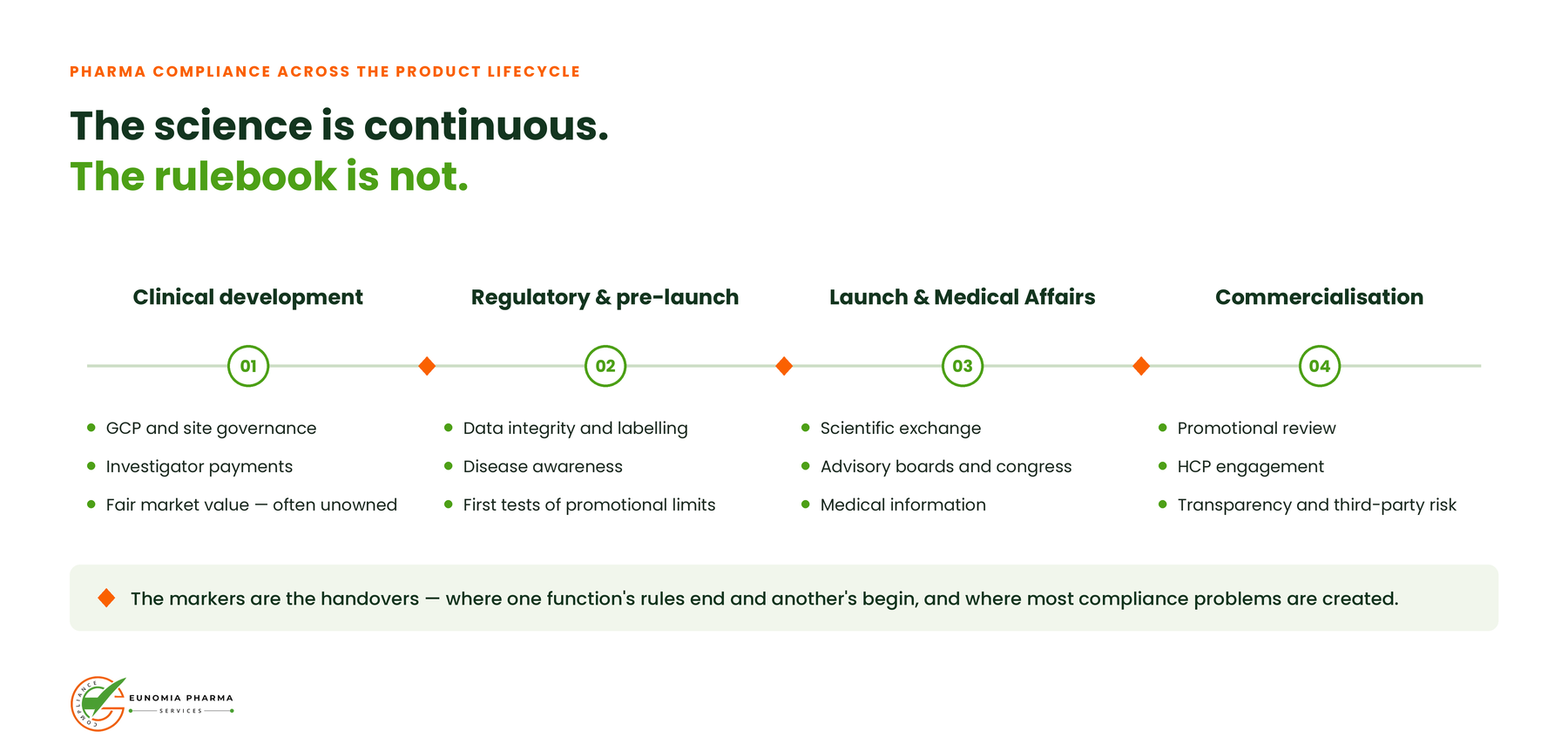
What changes, and where
Clinical development
Good Clinical Practice (GCP), investigator payments and site governance are central considerations. Alongside these sits a non-GxP compliance layer: how investigator fees are determined, whether a fair market value (FMV) methodology supports them, and how relationships and engagements are documented.
Regulatory and pre-launch
Attention shifts toward data integrity, labelling, and the boundaries between promotional and scientific activities. Disease awareness and scientific exchange require careful consideration of local requirements and of the distinction between promotional and non-promotional activity.
Launch and Medical Affairs
Advisory boards, congress activity and medical information bring obligations that differ from those at the clinical stage, yet may involve the same healthcare professionals (HCPs).
Commercialisation
Promotional review, HCP engagement, transparency reporting and third-party risk become ongoing operational requirements across the markets where the product is commercialised.
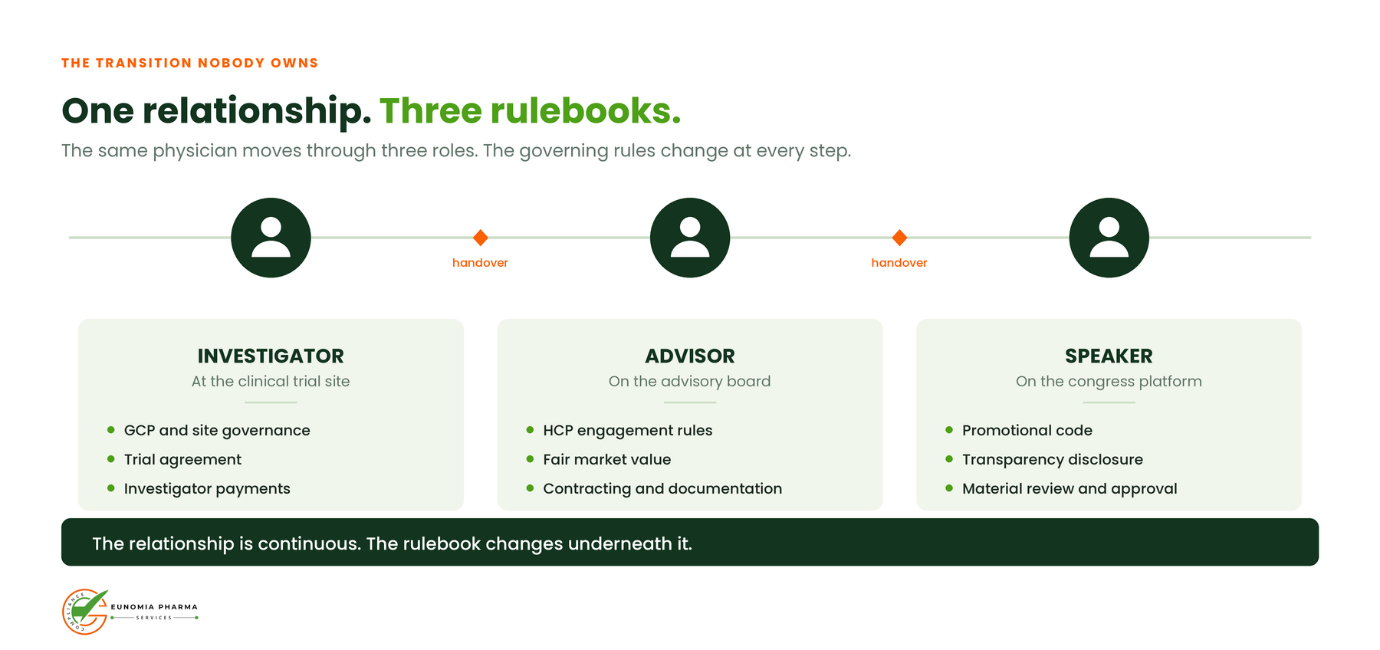
The transition between functions that gets overlooked
The same HCP may be an investigator, then an adviser, then a speaker. The relationship is continuous; the rulebook changes underneath it.
These handovers can become points of increased compliance risk when responsibilities, evidence and review processes do not carry forward.
Six signs compliance has become disconnected
Strong controls across Clinical, Regulatory, Medical Affairs and Compliance can still create friction and inconsistent outcomes when they operate independently:
- The same activity is judged differently depending on who reviews it.
- The same material is reviewed twice by teams unaware of each other.
- Approvals are delayed at functional handovers, with no defined owner.
- Evidence is held in separate systems and formats.
- Capacity is consumed by coordination rather than judgement.
- There is no end-to-end audit trail—the most consequential gap, because it may surface during an inspection, when it is too late to fix.
The answer is rarely more compliance. It is better-connected compliance: a defined owner at every handover, a review route that adapts to the lifecycle stage, systems that carry evidence forward, and governance proportionate to the actual risk.
Five questions worth asking
- Does our framework evolve with the product lifecycle, or was it designed around a single stage and inherited by the others?
- Are responsibilities defined at the handovers between functions?
- Can we trace a compliance decision back to the activity and evidence behind it?
- Are HCP engagement, FMV and transparency controls governed by a consistent framework that accommodates local requirements?
- Can teams make risk-based decisions quickly without compromising governance?
If any answer is unclear, that is a useful place to start. Compliance should not slow the product lifecycle down. It should help it move forward responsibly.
Building your compliance framework, strengthening an existing programme, or looking for additional operational capacity? Let's talk.