
Local Legal Mandates and Representation
In-market presence without in-country headcount.
Entering a market often requires someone who understands the local code, association expectations and regulator. We provide named local support and translate mandates into workable ownership, review routes, evidence and reporting.
Discuss this service
What we can take on
Support shaped around the work.
Local code interpretation and queries
Association liaison and self-regulatory filings
Cross-border HCP engagement review
Market-entry compliance assessment
Local transparency and disclosure requirements
What this gives you
Local context brought into global processes
Clear ownership and escalation by market
Faster market entry without unnecessary fixed overhead
Named local expertise
Local context, connected globally.
Explore our coverage. Select a red partner marker to open that compliance officer's biography on the Team page.
Hover over Europe to zoom in. Hover over a red dot to see a photo; click to read their bio.On mobile, tap “Zoom Europe”, then tap a red dot to read their bio. Red dots show team member locations.
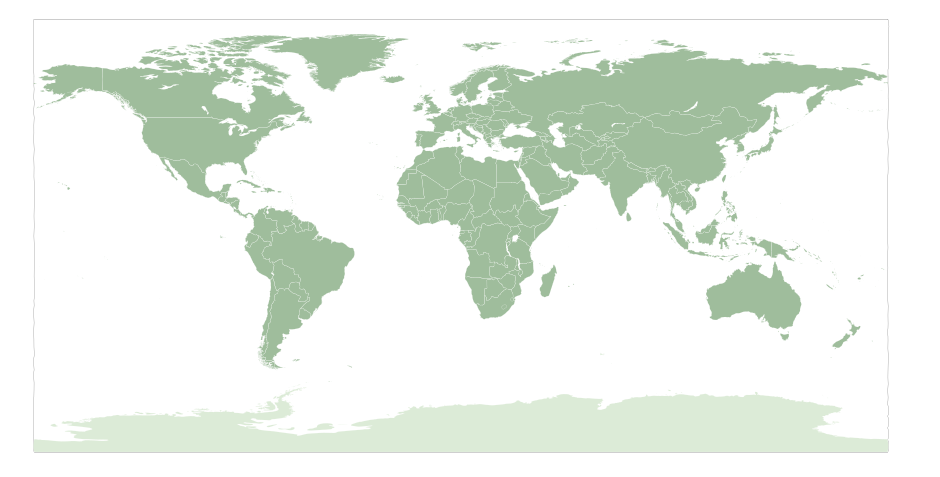
Service coverageHover or tap a team marker to meet your compliance partner.Europe · MENA · US · Brazil & South America · India · Southeast Asia · Japan
Legal mandates
Designed around the rules that sit behind the process…
We map legal and self-regulatory requirements into practical controls, review routes, evidence and ownership.
Anti-bribery and corruption
UK Bribery Act 2010—including section 7 failure to prevent and its broad territorial reach—plus the FCPA and OECD Anti-Bribery Convention.
Promotion of medicines
EU Directive 2001/83/EC, including the advertising and inducement framework for medicinal products.
National anti-gift and benefit rules
Country-specific requirements including French DMOS as amended by Ordonnance 2017-49, Portuguese INFARMED rules, and relevant Greek, Turkish and Polish regimes.
Failure to prevent fraud
The ECCTA 2023 offence, in force since 1 September 2025—a live control gap in many pharmaceutical third-party frameworks.
Transparency and disclosure
US Sunshine Act / Open Payments, France’s Loi Bertrand, Danish and Portuguese registers, plus the code-based EFPIA disclosure layer—translated into data, process and reporting controls.
EU AI Act and related regulation
Regulation (EU) 2024/1689, read alongside the GDPR, EU Data Act and, where AI forms part of a medical device or diagnostic, the MDR and IVDR—covering risk classification, data governance, transparency, human oversight, technical documentation, post-market monitoring and accountability.
Primary references
This overview is informational and does not constitute legal advice. Scope and application should be confirmed for the organisation, market, activity and counterparty in question.
Questions, answered
Local Legal Mandates and Representation FAQs
What does local compliance representation mean?
It means providing a named, market-aware compliance contact who can interpret local requirements, support queries and connect local obligations to your global governance model.
Which markets can Eunomia support?
Coverage includes EU5, more than 20 European markets, MENA, the United States, South America and Asia. Exact scope is confirmed for each engagement.
Can you interpret country-specific industry codes?
Yes. Support can cover local legal requirements, industry codes, association expectations and the practical implications for activities and documentation.
Do we need to open a local office?
Not necessarily. The appropriate model depends on the legal obligation and activity, but many compliance-support and representation needs can be met without permanent local headcount.
Can you support cross-border HCP engagements?
Yes. We can identify relevant home- and host-country requirements, establish the review route and document the rationale and approvals.
How does local support connect to our global team?
Named contacts, decision rights, escalation paths and reporting are agreed so local advice feeds into a consistent global operating model.
Tell us what is on your desk.
We will listen, ask a few questions and recommend the right scope—without obligation or pressure.
Start a conversation